This review is based on a ebook provided by the author for the purpose of an honest review.
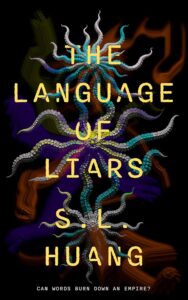
Sometimes a new release checks so many boxes that there’s no real question about whether I’ll pick it up, only about how long it will take me to get my hands on it. With an author I’d enjoyed in the past, thematic exploration of imperialism and oppression, and a plot centered on the difficulty of translation when dealing with species with radically different experiences of the world, S.L. Huang’s The Language of Liars was just such a book.
The Language of Liars is a long novella that uses linguistics minutiae to explore both imperialism writ large and a language-loving lead whose abilities cast him awkwardly in the middle of powerful machinations. If that description calls to mind R.F. Kuang’s Babel, there is reason for it, and indeed, I suspect Babel fans will quite enjoy The Language of Liars. That said, Huang’s offering is significantly shorter and a fair sight more subtle in its execution, so those who were critical of Babel for its pacing or moral self-assuredness shouldn’t let the comparison put them off. The Language of Liars does require patience for academic details, which will surely pose a barrier for some readers, but it isn’t written purely for an audience of linguists, and it remains engaging for those (like me) with little experience in that particular field of study.
It opens in an unassuming corner of a galactic compact with nary a human in sight, and it stars a member of a furred species with a hive-like social structure and an empathetic ability that allows them to jump into the bodies of the long-lived Star Eaters. Though such jumps are extremely rare, they remain a closely-guarded secret that’s vital to the continued survival of a race that otherwise has little leverage to ensure access to the Star Eater-mined meridian element that powers so much of society. The promise that the lead may one day execute a jump is the only reason his advisors tolerate his absent-mindedness and maddening tendency to shirk unpleasant responsibility. But when he does finally break through, those same barely-tolerated character traits make him a deeply unreliable agent, struggling to stay hidden while persistently questioning the orders relayed from home.
At the risk of applying human categories to alien characters, the lead comes off as neurodivergent—and not in the classic “there’s a race of aliens (or group of robots) who act like neurodivergent humans” sort of way; on the contrary, the lead is considered both exceptionally linguistically adept and exceptionally inattentive even among his own people. As such, relatability may vary from reader to reader, but I found it remarkably easy to immerse in his narrative, even without particular previous knowledge of linguistics. The bulk of the story features not so much imposter syndrome as being a literal imposter, but it still makes for a psychologically claustrophobic experience, with the lead forced to put on extended act without any confidants that may allow him to drop his guard. His fascination with some of the more puzzling attitudes and expressions common to the Star Eaters provides an overarching mystery that drives the story, and the way he bristles against the incurious attitudes from his own society will doubtless strike a sympathetic chord with large swathes of the sci-fi readership.
Though the clues to the puzzles are often linguistic in nature, the reader gets enough context from the lead’s internal monologue to understand the broad shape of the mystery, and each chapter opens with an epistolary snippet that provides further background on the history and culture of the Star Eaters. When combined with information from the lead’s training and firsthand behavioral observation, there’s plenty to puzzle over for readers from a large variety of backgrounds. In fact, I’d argue there’s sufficient foreshadowing for the reader to anticipate major elements of the final revelation. Often that’s a mark against a book, but I don’t find it to be so here, as the impact on both the characters and the thematic exploration give the revelations an emotional weight that hits even if some of the details are suspected in advance. Sometimes a gut-punch is a gut-punch, even if you see it coming.
Ultimately, both the resolution of the mysteries and its impact on the lead are inextricable from the major themes being explored. The heart of the story involves the former enslavement of the Star Eaters and how they have come to be willing workers in service of an alliance who had abused them for so long. And while the details are mostly delivered obliquely, through epistolary snippets and the lead’s experience impersonating a Star Eater, they nevertheless pack an emotional wallop and offer sharp challenges to societies trying to brush their darker histories under the rug. The fact that it’s a story largely about the treatment of the Star Eaters without any actual Star Eater perspective may draw unpleasant comparisons, but in this case, it’s a feature and not a bug. The storytelling perspective may prevent the reader from directly immersing into the Star Eater mindset, but the perspective choice shoulders thematic weight of its own that more than makes up for what is lost.
There are moments where the academic jargon can become distracting, but by and large, the lead is relatable, the mystery is compelling, and the ultimate resolution hits like a ton of bricks, both from an emotional and thematic perspective. One or two moments of being lost in linguistic minutiae doesn’t detract much from a book that checks so many other boxes—The Language of Liars is the best novella I’ve read all year, and it isn’t close.
Recommended if you like: exploration of unusual cultures, indirect commentary on imperialism and slavery, neurodivergent leads, academic puzzles.
Can I use it for Bingo? It’s hard mode for Unusual Transportation and Non-human Protagonist. It’s also Published in 2026 by an Author of Color and features plenty of Politics.
Overall rating: 18 of Tar Vol’s 20. Five stars on Goodreads.