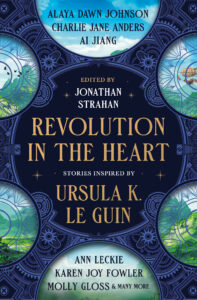
This review is based on an eARC (Advance Reading Copy) provided by the publisher via NetGalley in exchange for an honest review. Revolution in the Heart was released on September 22, 2026.
I’ve read less of Ursula K. Le Guin than many of my bookish friends, but it’s hard not to appreciate her towering influence over the most thoughtful corners of science fiction. Combine that with an impressive table of contents, and I was excited for the opportunity to read Revolution in the Heart, an anthology of stories inspired by Le Guin, edited by Jonathan Strahan.
Revolution in the Heart includes 15 original stories by 15 different authors, almost all of them women. While I don’t have precise word counts, I’d estimate that most of them sit between roughly 3,000 and 10,000 words in length. I’m sure the biggest Le Guin fans will be able to point to specific influences for most of the individual stories, but this is not an anthology of fiction set in Le Guin’s worlds. Instead, the editor asked for stories that would honor Le Guin’s memory, and the anthology is built from the different ways the contributors did so.
Again, I am not the best person to identify specific inspirations, but it’s not hard to see a few broad trends. There are, for instance, a whole lot of stories about either encounters with the alien or the treatment of the marginalized in society. That should come as no surprise, and both topics are rich with opportunities for storytelling.
Another common thread comes in the tone, with many of the stories taking on a voice that’s a fair bit more didactic than average. That may be a red flag for some readers, and I admit I’d have liked to see a bit more variance in approach, but it doesn’t have to be a bad thing, and while a handful of the stories in the anthology try to explain too much and end up muddled, some of the ones that most exemplify a more focused didacticism are indeed quality tales. Perhaps the clearest example is the opening story, Five-Eyed Jane by Ann Leckie, which starts with “once upon a time” and proceeds to detail a catlike alien species and the way they treat minorities. There are plenty of asides to the audience and an ending that’s not terribly difficult to predict, but it’s also an entertaining story that keeps the tone lighter than the subject matter. Mission accomplished.
Hold Me Close to Your Heart by S. Qiouyi Lu has a similarly appropriate didacticism. It’s a ghost story that features several essaylike musings on language, gender, and colonialism that make sense because…well, the lead is a student studying language, uncomfortable with their own gender presentation, and living in a place with a long history of racial discrimination. It’s completely in-character for the introspection to get a bit academic. There are times where the introspective segments feel a bit like rabbit trails, but they ultimately fit the character and make for a story that comes together nicely in the end.
The story where the tone most bothers me is Kelly Link’s novelette, The Monster’s Story, and that’s because of the way it shifts as the story progresses. The story consists of a series of nested narratives, told by prisoners to their captors in the heart of conflict. Link is well-known as an excellent storyteller, and the interwoven narratives are complex and powerful enough that the ending’s bluntness comes off as jarring. It certainly calls attention to the themes, which is surely the purpose, but it does so in a way that undercuts some of the subtlety of the story to that point, even if it remains a story worth reading on the whole.
Given my impression of “The Monster’s Story,” it likely comes as no surprise that my favorites in the anthology lean a bit harder into the subtext. Two of the shortest stories in the collection take familiar premises and tell them from unusual perspectives. First, Homestead by Molly Gloss delivers a “gunslinger visits a town that’s being taken advantage of” tale from the perspective of an opinionated and adventurous youth enamored with the new arrival. The general direction of the plot won’t be much of a surprise, but it’s recontextualized in a way that delivers a powerful message that’s quite a bit different from that you usually see in these sorts of stories. It’s an abrupt ending that mostly leaves the theme for the reader to infer, but it’s also not particularly ambiguous, providing a refreshing balance between having something to say and not beating the reader over the head.
Similarly, the anthology’s final entry, Blaumont by Karen Joy Fowler, tells of a rich man living on a poor island, keeping the inside of his house and what seems a revolving door of wives largely hidden while winning influence and respect through his money and mainland connections. Again, it’s a familiar setup, and experienced readers will likely guess major plot developments. But those predictable plot developments are almost an afterthought set against the way the lead’s perception of her people and their benefactor changes as the story progresses. Once again, it’s a familiar tale that delivers a different message when presented from an unusual angle. And for my money, this one is the strongest piece in the entire anthology.
Rounding out my three favorites is the shortest story in the anthology, A Shell in the Desert by E. Lily Yu. Once again, it’s a story with something to say about power and interaction with the other, but those themes are pure subtext in a short, dark tale about isolated individuals in eerie desert pools that supply all their needs and don’t take kindly to outsiders. Its trim word count is enough to establish a surreal and unsettling atmosphere, and it doesn’t linger long before delivering a powerful final blow.
In any anthology organized around a central idea, there will inevitably be a few storytelling patterns, and another seen several times in Revolution in the Heart is the personal tale that uses an explanation-heavy tone to detail an encounter with something the lead cannot at all explain. Perhaps unsurprisingly, the standout stories of this type are novelettes penned by a pair of exceptional writers: Sarah Pinsker and Premee Mohamed. Pinsker’s Traveling, Home features a woman living in an isolated Southwest community that had been the site of a shockingly ill-publicized alien incursion. The narrative mostly consists in her recounting of her previous life and how she came to the alien-adjacent community, interspersed with discussion of the ineffable means of teleportation that so captured the curiosity of a handful of residents. Pinsker is an expert in the novelette form, and this entry creates easy immersion, a satisfying conclusion, and a good bit of meditation on knowing a place and interacting with things you can’t understand.
Mohamed’s River Run Riot Run Dry also spends most of its time flashing back to the lead’s pre-migration life, but here there’s less focus on the inexplicable fantastical premise and more on its community reception. The lead’s best friend has an ability to prophesy that she can neither control nor explain. And while her religious, rural community doesn’t respond with the kneejerk hatred that one may expect from this sort of story, neither do they trust or understand. And so the lead and her friend must figure out what to do with some particularly foreboding knowledge amidst a community that will not accept it. Like with the Pinsker, Mohamed is an excellent writer and delves into the mindset of the lead in a compelling, nuanced, and ultimately satisfying way.
The Dark Below by Vandana Singh sees the lead joining an expedition to the melting glaciers of the Himalayas. While he’s there as a photographer, his deepest hope is to recover the body of his mountaineering brother, who had disappeared in the area years before. Like the Pinsker and Mohamed stories, there are significant flashback sections here, mostly taken from his brother’s journal entries. But those entries aren’t the entirety of the story—while they hint at the existence of something beyond the ken of humanity, it’s the present storyline with the opportunity to learn the truth.
Not all of the stories in the anthology keep the strangeness at a distance. Aliya Whiteley’s In One Substance stars an ambassador visiting a world of ascetics who had traditionally rebuffed efforts to establish trade. The host society makes learning difficult, but there are still chances to uncover snippets of mystery, even if the full picture and its consequences remain uncertain.
Many Light Objects by Chana Porter also dives into a strange world—or collection of worlds—one where pop stars perform exaggerated displays of emotion to the thrill of massive crowds. The lead is one of those pop stars, but the alien profession here is a window into the complicated relationship with an abusive father. I admit that I didn’t fully sink into the lead’s inner turmoil, but the unique setup and nuanced interpersonal plot definitely make this worth a look.
Darcie Little Badger also builds a fascinating setting into Soloist Nell, though with less use of aliens and more of a subterranean society beneath a scorched surface. The lead must intensely prepare for the dangerous trek above ground in search of resources, but it’s a story that gestures at mysteries while ultimately lingering in ambiguity. That’s certainly different from the dominant style in the anthology, but in this case, it left me wanting a little more.
As I mentioned at the start of the review, there are a couple others that come off a bit too muddled and never fully engaged me, and the anthology as a whole does suffer a little from the stylistic clustering that often threatens themed anthologies. But most of the stories make for entertaining reads, and there are a handful of true standouts that make it worth tracking down the anthology. It’s not without its flaws, but it delivers enough compelling stories and fascinating themes to make for an overall quality read.
Recommended if you like: short stories inspired by Le Guin, the authors in the table of contents.
Can I use it for Bingo? It’s hard mode for Five Short Stories, and is also Published in 2026 by a (relatively) Small Press.
Overall rating: 15 of Tar Vol’s 20. Four stars on Goodreads.