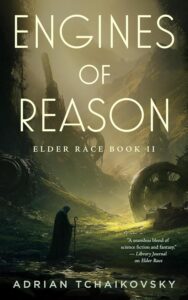
This review is based on an eARC (Advance Reading Copy) provided by the publisher via NetGalley in exchange for an honest review. Engines of Reason was released on September 1, 2026.
Elder Race is a nearly perfect novella and is my favorite thing that Adrian Tchaikovsky has written. It doesn’t need a sequel. But when the sequel was announced, was there any real chance I wouldn’t give it a try? Nah. Maybe if it had been 600 pages, but at novella length, the worst-case scenario is a couple unpleasant hours of reading and subsequently pretending it doesn’t exist. And I didn’t exactly consider that likely when I picked up an ARC of Engines of Reason. After reading one page, “unlikely” shifted to very nearly unthinkable.
[While I will avoid specifics about plot details of Elder Race, this review will inevitably include some basic information, such as “who is still alive at the end of the first book?”]
Elder Race alternates chapters between a princess enlisting a reclusive sorcerer to aid her quest to defeat a demon and an anthropologist trying not to meddle in the affairs of the technologically backwards people he’s meant to observe. It should come as no surprise that the anthropologist is the sorcerer, and the linguistic differences between their point-of-view sections are one of the many reasons to love the book. In Engines of Reason, which takes place years later, those perspective characters return, to be joined by another local who happens upon a store of magic that may help him fight back against an increasingly oppressive empire.
Engines of Reason is not Elder Race. To expect all the same magic is to set oneself up for disappointment. There are still linguistic differences among the perspective segments, but as the sorcerer-anthropologist interacts more with the locals, the difficulties in translation become less pronounced. And while his melancholy tendencies haven’t vanished entirely, he’s no longer mired in the depths that made Elder Race such a stunning portrait of the battle against depression. Engines of Reason is a different book, as it has to be.
Instead of language and mental health, Engines of Reason focuses squarely on the stories that people believe about themselves and the ways in which those stories shape their lives—and, insofar as they have power, the lives of anyone touched by that power. A ruler believes herself to be persecuted and so becomes controlling of her allies and bellicose toward her perceived enemies. Another believes herself to be disdained and so becomes cagey and avoidant of former friends and family. And, as the introduction suggests, another becomes so lost in her own story that it devours her.
These themes come out in a story whose general plot structure is a familiar one. New magic—constructed largely out of old tech—arises, a sorcerer is called to come against it, things get more complicated than he anticipates. And while it’s not going to wow anyone on plot alone, and there may be a couple of developments that feel a touch too quick, it’s an entertaining structure around which to build the much more interesting story of the people involved.
As a huge fan of Elder Race, I suspect I would’ve enjoyed the stories of those people even were they of middling quality—perhaps at anything short of outright character assassination. But while simply getting to spend more time with beloved figures is a big part of the draw, Engines of Reason digs into intriguing conflicts, both internal and external, that go beyond what was addressed in the previous book while still staying true to the core of the characters. Those conflicts give this book a compelling pitch beyond just getting to spend more time in a beloved setting, and at a time where stories about national myth are at the center of genre-conversation, Engines of Reason is particularly apropos. It’s not so concerned with national myth per se, but the handling of those more personal self-conceptions are inextricably bound up with larger-scale myth-making. All tied together with an entertaining plot and a terrific setting, it makes for quite the read in its own right.
Engines of Reason does leave an enormous hole to be filled by further sequels, but it’s also plenty satisfying in its own right, wrapping up the book two plot while maintaining series-level questions for further exploration. It’s just different enough from the previous book to justify its existence, while keeping enough continuity to be an excellent read for fans of the first entry. This may not be an all-timer, but I had a wonderful time all the same.
Recommended if you like: Elder Race, blends of sci-fi and fantasy, stories about stories.
Can I use it for Bingo? It’s Published in 2026 and features both an Older Protagonist and Politics or Court Intrigue.
Overall rating: 17 of Tar Vol’s 20. Five stars on Goodreads.