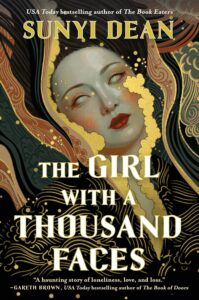
I heard plenty of good things about Sunyi Dean’s fantasy debut a couple years back, but I never got around to trying it for myself. With even more positive reviews coming out about her newest novel, The Girl with a Thousand Faces, I made sure to quickly move it up the list.
The Girl with a Thousand Faces is a ghost story that opens in the infamous Kowloon Walled City of the 1970s. The lead, an aging woman who had been forced to build a life from scratch after emerging with total amnesia from World War Two devastation, uses her affinity for communicating with ghosts in service of a moblike organization that imposes what order there is in an enclave without a real governmental structure. But when her forgotten past begins to manifest in the present, she must piece together her history or risk the destruction of everything she’s worked to build.
Perhaps unsurprisingly, in a story about uncovering forgotten history, The Girl with a Thousand Faces dances through various timelines, but it doesn’t do so with anything near a simple alternating structure. Instead, it’s more ambitious, opening with a heavy focus on the most recent (1970s) timeline with a few glimpses of the 1940s before later shifting to a story predominantly set in the earlier timeline, with the older tale itself providing small glimpses of a yet earlier time. Then the story returns to the initial conflict, with reader and character alike possessing the necessary understanding to appreciate its true depth.
The result is a story that opens fairly as action-heavy before developing into a much more character-driven tale. While I more often see the progression go the opposite direction, both elements work well here. The day-in-the-life ghost-talking introduction is compelling, and both the forgotten history and contemporary threats provide plot hooks to keep the reader invested. But rather than devolve into a series of action sequences to fill a few hundred pages, the character development provides depth and richness that makes the book much more than thrilling fun.
Both the plot and character development work together to serve the themes, which touch on war, poverty, and city politics while maintaining a strong focus on vengeance and interpersonal wrongdoing. But again, The Girl with a Thousand Faces doesn’t fall into the well-worn grooves of the action-heavy revenge tale. Make no mistake, there is action, and revenge is vital to the plot, but it’s much less about the catharsis of vengeance and more an exploration of cycles of violence and the myriad decisions made in the search of a way forward.
While I have a lot of good to say about plot, character, and theme, The Girl with a Thousand Faces does have an unfortunate tendency to break my immersion. While it’s set in the past, it’s not necessarily written as a period piece, and an author’s note at the end explains some of the translation choices involved in telling a story populated mostly with 20th-century Cantonese-speakers to an audience of 21st-century English-speakers. But even allowing for translation into contemporary language, there are some moments that just don’t feel right for the period, like the denizen of a lawless slum remarking drily about rental contracts, or the narrator characterizing a father as prone to toxic self-flagellation. Suspension of disbelief can be idiosyncratic, but mine broke on several occasions, particularly in the book’s second quarter. That’s not to say the prose is bad—on the whole, it’s readable and engaging—but there are times where it shifts a hair too far toward explaining things to the contemporary reader.
That small sense of distrust of the reader does color what had the potential to be a tremendous read, but The Girl with a Thousand Faces remains very good. It’s well-paced, with an interesting structure that serves the story well. The characterization, plot, and themes are all on-point. For a reader who doesn’t mind a little bit more contemporary style, this could be a favorite.
Recommended if you like: uncovering buried secrets, reckoning with cycles of violence.
Can I use it for Bingo? It’s hard mode for The Afterlife, and it is also Published in 2026 by an Author of Color and feature an Older Protagonist.
Overall rating: 16 of Tar Vol’s 20. Four stars on Goodreads.