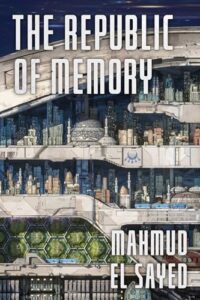
This review is based on an eARC (Advance Reading Copy) provided by the publisher via NetGalley in exchange for an honest review. The Republic of Memory was released on May 5, 2026.
Short Fiction Book Club picked up “Memories of Memories Lost” by Mahmud El Sayed a couple years back, and it remains my favorite of our reads that I had not personally recommended for discussion. So I really only needed title and author to be extremely excited for El Sayed’s debut novel: The Republic of Memory.
The Republic of Memory opens a sci-fi duology set on a generation ship and pitched in short as “Arab Spring in space.” The ship was sent out by an Islamic empire that had conquered nearly everything outside of North America. Its hold shelters cryogenically frozen experts from across the empire whose skills would be vital to building a society on a new world. And on the journey itself, the ship was to be run by family members of these experts. But when they heard a distress call from Earth and the ship’s AI insisted on turning back to provide belated aid to a world on the brink of nuclear annihilation, the crew rose up to overthrow the AI and build a new society of themselves and their descendants, culturally sorted by language rather than politics or religion, all organized around the jobs necessary to keep the ship functioning for the duration of its journey. Fast-forward a couple centuries, and the best jobs are being hoarded by the same families that had had them years before, the administration provides empty platitudes in response to increasingly worrisome electrical issues, and revolution is in the air. And The Republic of Memory details the beginnings of that revolution, from the perspectives of well-meaning administrative workers, youthful agitators, subversive political leaders, and more.
Perhaps the most initially striking element of The Republic of Memory is its use of language. It’s something I rarely see explored in generation ship tales, which most of the time have a common tongue. But this ship is full of linguistic enclaves that struggle to communicate without the aid of Translators, who function almost like lawyers in the way they prepare paperwork and smooth administrative barriers for negotiations of various sorts between people from different linguistic backgrounds. There’s also a ship-born creole popular among the young and the marginalized. It’s clearly inspired by the slang in A Clockwork Orange, but it dispenses with the assumption that English and Russian would dominate culture, resulting in a tongue heavily influenced by English, Russian, Portuguese, Arabic, and a handful of others. Dubbed “Nupol,” it’s sprinkled into the sections from the perspective of those who speak it, with two of the 32 chapters written almost entirely in Nupol. As an English-reader, those segments made for slightly slower reading, but they remain comprehensible even while highlighting the shipboard cultural diversity.
That development of such a rich, diverse shipboard culture is the greatest triumph of The Republic of Memory. Yes, there is a revolutionary plot, and it’s an interesting one. But the way the ship culture and its constituent smaller cultures are brought to life is the true stunner. The world feels deeply lived-in, and characters come to life right along with it. There’s no stark divide between the elite and the revolutionaries. Even among the administration, there are those with deep misgivings about the political state of the ship who desire to remedy the problems by working within the system. And among the disaffected, there are sects seeking Arabic-language supremacy, others seeking the freedom to build churches, others striving for a proletariat uprising and seizing the means of production, and still more working for overthrow of the administration and waking of the cryosleepers. Not only does the diversity of viewpoints both within the administration and outside of it make for a world that feels real, it also makes for a situation that’s much more intricate and politically sensitive than one often finds in revolutionary stories.
The first half of the novel plants the seeds of the overarching plot, introduces several compelling characters, and brings to life a stunning world that sets The Republic of Memory on track to become a potential book of the year. Then, in an audacious move, the second half of the novel drastically shifts the mix of perspective characters, introducing new angles and plot threads even as the revolutionaries continue to work for radical change. While this makes for a second half that’s a bit plottier and less focused on the overall world, that plot remains interesting, and the newly central characters bring plenty to the table.
Unfortunately, The Republic of Memory is incomplete. Of course, some of that comes with being the first in a series—I grew up on epic fantasy, I’m no stranger to long-running plot arcs. But the best epics close a major arc in the first book, even while opening bigger ones, and The Republic of Memory falls a bit short in that regard. Yes, there’s enough development of the revolutionary plotline to justify the book’s existence as a story and not merely a prologue, but some of the biggest first-book questions never get real answers in the near-term. We knew in advance that there would be plenty left for the sequel, but there’s a balance between the already and the not yet, and that balance wobbles too far in the latter direction.
The result is a book that remains a stunningly impressive debut novel that’s easy to recommend, but also one that lacks closure and is unsatisfying without the sequel. As a series-starter, it’s good enough to make the sequel one of my most-anticipated books of whatever year it comes out. But an ending that leaves too much for that sequel keeps it from fulfilling its lofty potential as an annual favorite.
Recommended if you like: generation ship stories, intricate politics, rich cultural worldbuilding, language.
Can I use it for Bingo? It’s hard mode for Published in 2026, Duology Part One, and Politics. It also is written by an Author of Color, and I’d argue you could Judge a Book by Its Title.
Overall rating: 17 of Tar Vol’s 20. Five stars on Goodreads.