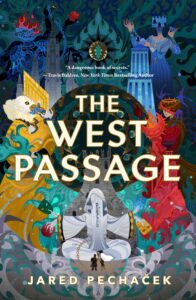
When Jared Pechaček’s debut novel, The West Passage, came out last year, I heard no shortage of praise from my usual circles. However, much of the praise was for the weird worldbuilding (not usually a huge selling point for me), and it appeared to have a quest plot structure (something I actively dislike), so I let it pass me by at the time. But when Pechaček was nominated for the Astounding Award for Best New Writer, I decided to at least read a few sample chapters to see whether it might surprise me. And, while my initial impression was fairly accurate, the quality of the sample certainly did enough to convince me to give this one a closer read.
The West Passage takes place in a sprawling complex heavily inspired by the strange art in medieval manuscripts. There are bipedal, sentient creatures with all sorts of non-human features, all spread across five towers founded by mind-bending Ladies. The two leads hail from the crumbling Grey Tower, which has had no Lady for many years. Both young leads are apprenticed to key leaders, but before they can settle in to the roles they’ve trained for, both see themselves making the dangerous journey to the Black Tower to seek aid in the face of perilous changes.
There certainly are details of why these journeys are necessary, but both quickly devolve into episodic quests that make it difficult to keep the main goal in mind. There’s never any doubt about the looming peril, but exactly what each lead may realistically accomplish on their journeys is much less clear. Instead, the book is mostly concerned with a dizzying tour of a bizarre world full of strange and capricious individuals, all while slowly unraveling bits of history that may prove vital in the final confrontation. As I mentioned, I don’t care much for quest stories, but I do quite enjoy tales about uncovering suppressed histories, so part of the major thrust of The West Passage is one that appeals. But the real reason I kept reading after the first handful of chapters was simply the quality of the scene-level storytelling. The world is deeply weird, and the author brings that weirdness vibrantly to life, all in a way that deeply affects the lives of sympathetic leads with compelling goals. It’s clear from the beginning that the plot will be episodic, but the other boxes are checked.
Unfortunately, I still struggle with episodic plots, particularly when sustained over long stretches, and at nearly 500 pages (on my digital copy), The West Passage isn’t a short book. After the dual-perspective first section, the main characters spend long stretches apart, with nearly 300 pages in the middle consisting of them finding strange new beings, being assigned new tasks, and sometimes facing threats upon life or limb. There’s no lack of strangeness in those encounters, but. . . well, it’s the structure of a quest story, and those tend to settle into monotony in my eyes. This is surely not a universal experience, or else the story type wouldn’t be so popular, but the quality of the prose and strangeness of the world aren’t enough to keep so many of those intermediate episodes from blurring together in my eyes. So despite a fairly clear danger at the outset, myriad threats along the way, and plenty of foreshadowing as to the nature of the ultimate conflict, I found my emotional connection steadily waning through the intermediate stages of the story. And once the emotional connection wanes, it’s devilishly difficult to recapture it.
The West Passage, however, does make a pretty good go at the end. The final conflict ties together so many different threads, paying off previous hints and intimations in a way that makes clear that the story was never just a jaunt through a weird world—it was always going somewhere, and its final destination has a lot to say both about the bizarre world of the story and the much more mundane societies of the every day. The suppressed history comes good, and it ties together in a satisfying fashion. Truly, it’s just the ending the story needed.
On the whole, The West Passage is a book I appreciated more than loved. The episodic structure and world-centeredness fit my taste awkwardly, and the episodes run long enough to see my attention wandering. But the author’s storytelling skill is on clear display, and the start and the finish leave me with a more positive impression than I’d have expected from its plot structure, even if the impression is not wholly positive. There’s a lot of good here, and it’s easy to see it being great for the right reader.
Recommended if you like: quest stories, weird worlds.
Can I use it for Bingo? It’s hard mode for Trans or Nonbinary Protagonist, Unusual Transportation, and Politics and Intrigue. It’s also a Book Club selection that works for Feast Your Eyes on This.
Overall rating: 14 of Tar Vol’s 20. Four stars on Goodreads.