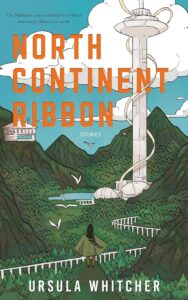
As a short, small-press novel, North Continent Ribbon understandably flew under the radar upon release. But a Le Guin Prize nomination caught my attention, and a few scattered recommendations kept periodically reminding me that I really ought to read it one of these days. And this fall, I finally gave Ursula Whitcher’s novel-in-stories a try.
North Continent Ribbon is told through six different stories, all set in different time periods with different characters. The thing that brings them together is the shared setting on a planet in the midst of major political changes, particularly surrounding the rights of workers, encroachments on indigenous land, and safeguards on AI.
Before picking up North Continent Ribbon, I’d seen it described both as a novel-in-stories and as a linked short story collection, with no real consensus as to which designation is more apt. But as someone who reads a lot of short stories, I have come down pretty firmly in the former camp. The individual stories do have some sort of resolution—usually in the form of the main character making a decision that turns on their relationship with loved ones—but taken alone, they feel curiously incomplete in their emotional arcs. But when taken together, the final story serves as the culmination of all those small, individual decisions made along the way.
Of course, even when viewed as a novel-in-stories rather than as a story collection, one’s experience reading it still depends heavily on how one responds to the individual stories. For me, that was a bit of a mixed bag, although the writing quality is high enough that even the more underwhelming stories are still reasonably engaging, even if they sometimes come off as underbaked. My chief complaint ties into the romantic elements, which play heavily into the climaxes of the first three tales and serve as vital backstory in the final story. By and large, these romantic elements are well-established long before the climaxes, but there’s a difference between being established as a story element and as the heart of the entire narrative. To serve as the latter, it’s generally necessary to build the emotional connection such that the reader feels the power of the lead’s romantic impulses. But the biggest strengths of North Continent Ribbon don’t tend to be its character work, resulting in stories that lack punch when considered on their own. And while this criticism absolutely does not apply to every single story, it’s concentrated in the book’s first half in a way that will likely drive off readers who may be more apt to enjoy the later portions.
On the other hand, the book is at its best when diving deep into the world’s fraught politics. It is the political element that serves as the true climax of the novel writ large, and on the way to that final story, the politics of the world plays a noticeable role in every story. This comes out most clearly in the two longest sections of the novel: the second and the fifth. Both would sit comfortably in the novelette range if taken on their own, and both feature leads who from the very beginning care deeply about the way the world works. The former stars a public servant—one with a reputation as the man who gets things done—who makes up one piece of a committee that dictates much of the fate of the land. Pressed by violent uprising on one side and apathy or active corruption on the other, he’s not in a position to single-handedly remedy all the ills that plague society. But he cares, and that care makes for one of the most gripping reading experiences of the entire book, even if the resolution yields only pieces of what is still to come instead of a shining triumph.
The fifth story stars a young aristocrat with a fondness for prohibited areas of study and a tendency to drive away expensive tutors. Despite the lead not being a well-established political actor, these youthful rebellions against the current order not only echo into the future, they also make for one of the most satisfying chapters when taken as a self-contained narrative.
I’ve gone this far without mentioning the ribbons referenced in the book’s title—they serve as outward signals of obligation to another, and whether they’re worn secretly, openly, or not at all plays a significant role in each character’s perception. Changes in these outward markers often serve as major emotional shifts in the narrative, and it’s the network of obligations that unifies both the romantic and political storylines I’ve discussed already.
Those storylines play off each other in most of the individual chapters, but they’re most clearly unified in the final story. As I mentioned already, the romance that gets the plot rolling requires a bit more suspension of disbelief than I’d prefer, but once it’s established, that final chapter grows into a powerful tale of organized labor that is both satisfying on its own and serves a fitting culmination of everything that came before.
That powerful finish, along with the careful political exploration, make North Continent Ribbon a compelling read, both for the themes and for the way the individual tales build on each other over time. However, the weaker character work fails to fully motivate the romantic elements, disproportionately affecting the first three of the novel’s six constituent stories. The result is a book that’s worthy but imperfect. It’s sufficiently short and well-written that even the weaker stories never turn into a true slog, but they still make it harder to stay invested for the finish—particularly for readers accustomed to more traditional novel structures.
Recommended if you like: mosaic novels, organized labor, quiet sci-fi.
Can I use it for Bingo? It features plenty of Politics and is published by a Small Press.
Overall rating: 15 of Tar Vol’s 20. Four stars on Goodreads.