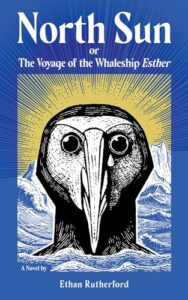
North Sun, or The Voyage of the Whaleship Esther, was entirely off my radar in the first year from its release. But one of the questions I ask annually in my Hugo Readalong is which books from the previous year were snubbed in the nomination process. And when someone advances something I’ve never heard of as a book of the year, it piques my interest. And so I headed to the library to pick up a copy of Ethan Rutherford’s debut.
North Sun takes place at the end of the whaling age, following the titular voyage of one particular whaleship, sent north in part for whale oil, but mostly for the recovery of another captain who had never returned from his previous voyage—and thus had not returned the item so dear to his employers. It opens feeling much like a historical novel from the perspective of a seasoned captain, but when the Esther sets to sea, the perspective largely shifts toward a pair of boys on their first voyage, and the plot becomes increasingly surreal and unmoored from its historical inspiration.
Perhaps the most immediately eye-catching element of this novel is the division into extremely short, staccato subchapters. The major divisions are standard enough, but almost all of the hundreds of (numbered) smaller ones consist of a page or less. I don’t think any of them are more than two. That creates a lot of additional white space that makes the book read significantly shorter than its listed count of nearly 400 pages, but it also interrupts the narrative flow in a way that discomfits the reader, taking away the expectation of tight, personal perspective and lending the narrative a dreamlike feeling that will only increase as the book progresses.
The basics of the plot are fairly simple to follow, although some of the speculative details can be hazy as the story becomes increasingly surreal. But this is also not a story about the plot—the plot is the scaffolding on which to hang the feelings. Because for a story that so frequently interrupts any sort of interiority with chapter breaks, it captures a whole lot in those brief flashes.
The clearest overarching theme here is the wantonness of environmental destruction. Everyone knows that the whaling industry is dying, and they know that it’s horribly wasteful too. And yet here they are, squeezing every last drop they can, dismissing environmental concerns as the cost of doing business. There are a handful of truly hard-hitting scenes on this subject, but it’s an undercurrent throughout the entire narrative, with the more subtle scenes giving the work as a whole more power than if it had been preaching from start to finish.
The other element brought vividly to life is the love/hate relationship that the whalers have with the sea. The stereotypical sailor who cannot function on land appears several times, and yet the journey itself feels less like a love affair and more like a desperate attempt to escape the maritime perils and return to safe harbor. For all that the characters may not be able to live without the sea, it’s cast as an enemy much more than a lover. It’s a bit of cognitive dissonance that feels true to life in a way that gives the narrative an emotional grounding even as the plot spins out of control.
The book also lingers long on the traumatic experiences of the boys on their first journey, though it deals much more heavily with the emotional aftermath than the events themselves. Their personal story is just as heavy as the large-scale environmental one, and while I found the captain a bit more compelling as a character, the boys certainly make for interesting reading.
On the whole, North Sun is a book that left me feeling like I’d read something significant, even if the details of why sometimes escaped me. I’ve seen it compared to Jeff VanderMeer’s Annihilation, and it reminded me of my experience reading Anne de Marcken’s It Lasts Forever and Then It’s Over. That’s not to say it’s a stylistically similar read, but the strange and unsettling qualities are doubtless a match. This isn’t one for the plot fans, but if you like the surreal, vibey, and thematic, give this one a serious look.
Recommended if you like: magical realism, seafaring novels, surreal books with environmental themes.
Can I use it for Bingo? It’s a Book Club selection published by a Small Press.
Overall rating: 17 of Tar Vol’s 20. Five stars on Goodreads.