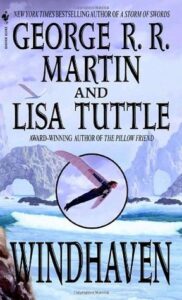
I’ve heard for a long time that George R.R. Martin was a titan of SFF well before branching into epic fantasy, but while I’d meant to circle back to his older work, there was always something a bit higher on the TBR. Then I saw a review of Windhaven, a fix-up novel consisting of three novella-length sections which came highly recommended and also fit a couple tricky Bingo squares. And so it was finally time to read an older Martin book, this one co-authored by Lisa Tuttle.
Windhaven takes place on an ocean world where scattered islands are separated by stormy, monster-infested waters that make sea travel an uncertain proposition even in the best of times. But the world’s residents have constructed enormous wings from the ruined ships of their spacefaring ancestors, allowing a small number of people to ride the winds and provide communication between islands. With no new wings being constructed, they’re a precious resource, passed down across the generations of flyer families. But the lead, a fisherman’s daughter who had always dreamed of flying, wants a pair for herself. And her attempt to get one will change their world in ways she’d never foreseen.
While just one novel instead of a series, Windhaven is structured very much like The Long Price Quartet (and I wouldn’t be surprised if the latter took inspiration from the former), with a prologue in the lead’s early childhood, an epilogue on her deathbed, and three main stories taking place at pivotal moments of her life. The first intially feels like it could serve as a standalone, only to see the long-term effects of the climax explored at length in next two parts.
I’d never previously read Tuttle’s sci-fi, but Martin’s writing is notoriously excellent, so it comes as no surprise that all three sections are wonderfully written. Even when the stories are straightforward, the world outside and the lead’s inner world come vividly to life in a way that elevates the story beyond that simple structure. And in the first novella, that about sums it up. The lead has an obvious structural obstacle to her goals, and it wreaks havoc on her emotions and spurs her to action that will have big consequences, but while her path has its twists and turns, it’s not an especially intricate plot. The excellent storytelling makes it a pleasure to read, and it provides plenty of satisfaction—even if a few doubts may linger in the reader’s mind—but it’s not breaking new ground.
The second novella, on the other hand, is stunning. All those lingering doubts from the ending of the first? Confronted head-on. All those raw emotions? Deeper and more mature. The political climate? Vastly more complicated. This isn’t a tale of pushing back against inflexible tradition but a reckoning with years of fallout, from economic pressures to interpersonal bitterness to ever-deepening divides between social classes. In a way, this second piece is more action-heavy than what preceded it, as a competition to test flying ability is the centerpiece of the narrative. But even with the increased focus on physical skill, it’s a story that’s vastly more intricate on almost every level, from the political to the interpersonal to the intrapersonal distress in the mind of the lead. And it all comes together beautifully, with each piece locking into place in a way that’s immensely satisfying while not neglecting any of the myriad plot threads building to the ultimate conflict. This was initially published on its own—albeit in Analog, the same magazine that published the first part—and it’s hard for me to say just how good it would be without the emotional context from the first story. The backstory is explained, but as pure backstory, it by necessity lacks the depth and richness of a full novella. But when reading it as part of a larger whole, it’s absolutely exceptional.
The third part feels less like an exploration of the inevitable fallout of what had happened before and more like a further story in a fascinating universe. But make no mistake, while the conflict may not be an obvious, direct consequence of the conclusions of the two previous sections, it remains inextricably bound-up in the political shifts brought about by the first two novellas. The lead from the first two novellas returns, this time decades older and forced to reckon with her body breaking down in a way that could prevent her from returning to the skies. Set against this personal story is a political one, where the brazen ruler of one island presses for power in a way that could permanently alter the relationship between flyers and landsmen if allowed to stand unchecked. Like in the second part, the political element offers tons of complexity, even in a story where the primary conflict seems to be in the mind of the lead. It’s not quite as stunning as the story that preceded it, but it remains an excellent tale of an aging lead trying to find her place in society after events threaten her familiar role. The political machinations—and the romantic subplot!—only add depth to a quality, introspective work.
On the whole, I wasn’t surprised to find Windhaven a well-written and enjoyable read, but I was surprised by just how thoroughly I was hooked. All three stories are excellent in their own right—with the second standing out even beyond mere excellence—and their arrangement into a unified work only strengthens the individual pieces. They build on each other in their worldbuilding, even more so in their politics, and perhaps most of all in their characterization, providing the portrait of an aspiring flyer from childhood to old age, with three pivotal moments where her internal conflict plays an integral role in a pivotal moment in her world’s politics and culture. This may be an older book than I typically review, but it stands up wonderfully.
Recommend if you like: worldbuilding, characterization, politics, sci-fi. It hits the high notes.
Can I use it for Bingo? It’s hard mode for Unusual Transportation, Game Changer, and Older Protagonist. It also has a One-Word Title and features plenty of Politics.
Overall rating: 19 of Tar Vol’s 20. Five stars on Goodreads.