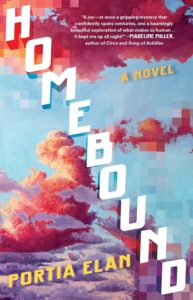
Homebound is one of those books that means to be marketed more heavily outside genre spaces than inside them, but after a couple of friends read and enjoyed it, I decided to grab a copy and give Portia Elan’s debut a try.
Homebound takes place along several different timelines, with connections that become more clear as the story progresses. I haven’t checked page counts to confirm, but the ones that subjectively feel like the main timelines are also the farthest separated in time. In the first, a 1980s computer science student navigates life after the death of her inspirational uncle, while far in the future, the captain of a small ship tries to pay off her debts and keep her partner alive by smuggling drugs across a drowned planet with little surviving technology. In between, there is the story of an astronaut undergoing a rescue mission, an academic working tirelessly to improve ecological balance even when the big money is being dumped into space travel, and an AI with memory gaps seeking purpose and belonging.
I knew going in that this book would likely read a little more literary than genre, but I was still surprised by exactly how plot-light it is. Had my expectations been more accurate, I wouldn’t have spent so much mental energy trying to piece together just how all the plot threads would converge. Make no mistake, there are non-trivial connections between them, but they exist more as parallel journeys with historical connections than as interwoven plot arcs with a climactic convergence.
Apart from the historical connections, the unifying feature across every timeline is a search for belonging and healthy community. That search often comes alongside what looks to be a driving plot, but as the story progresses, it’s always the community element rising to the fore. Elements that feel like the setup to major confrontations—a billionaire developing generation ships, rejection by a romantic interest—fade into the background as the cast’s personal journeys move in different directions: a crotchety ship’s captain finds family, a researcher spills her heart to an absent colleague who understands her in a way those around her do not, a closeted young woman finds there are so many who will welcome her as she is. Even if they may look otherwise, these stories are never about saving the world, but rather trying to live well in it, empowering and being in turn empowered by the people at your side.
Those are stories worth telling, and it becomes easier to sink into them once you stop waiting for big plot-related shoes to drop. Homebound is never going to be a particular page-turner, without a driving central plot and with a lot of switching between perspectives, but it is well-written at the scene level and makes for an engaging read throughout. The searches for community and purpose are compelling, though there are times where the story reaches for extremely specific emotions that will doubtless hit much harder for readers who have experienced them firsthand. This comes out most clearly in the 1980s story, where so much of the narrative climax relies on the discovery of queer community. The yearning comes through strongly enough to engage the emotions of a reader who has never been compelled to hunt for that particular community, but the payoff feels like it could read as a massively cathartic moment for someone who has experienced the search firsthand but that feels farther removed to me as a reader who hasn’t.
That storyline in particular gives Homebound the feel of a love letter to those who came of age in the closet, but that’s certainly not the novel’s only concern, nor is it the only thing that’s done well. Though it won’t satisfy those looking for a lot of plot, it’s a consistently engaging search for purpose and community across time and space. For those who read more on the litfic side of speculative fiction, it could be a real winner.
Recommended if you like: speculative litfic, finding community.
Can I use it for Bingo? It’s hard mode for Published in 2026 and Older Protagonist. It also fits One-Word Title, Game Changer, and Non-human Protagonist.
Overall rating: 15 of Tar Vol’s 20. Four stars on Goodreads.