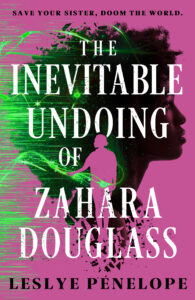
This review is based on an eARC (Advance Reading Copy) provided by the publisher via NetGalley in exchange for an honest review. The Inevitable Undoing of Zahara Douglass was released on August 11, 2026.
With her roots in fantasy romance, Leslye Penelope is an author I’d seen discussed but had never really sought out in the past. But I’m always intrigued by a “loved one disappears and only the lead remembers them” hook, and The Inevitable Undoing of Zahara Douglass offers just that. So I decided to take a look at a book that combines fantasy, family, and an interrogation of the role of technology in contemporary life.
The Inevitable Undoing of Zahara Douglass is set in the 1990s, with the majority of the story taking place in December of 1999, just before the final reckoning with the Y2K bug. It’s told primarily from the perspective of the title character, finally investigating her sister’s disappearance after years of failing to dismiss her memories as the fantasies that everyone had told her they were. This investigation is interspersed with logs from her sister’s computer—visible to the reader, not to the character—and video reflections of her father’s time in Vietnam and its long reach into civilian life.
While the magically-disappeared sister provides an intriguing hook, it’s not necessarily one that fits naturally into a novel-length story—I’ve seen this plot far more often in short-form than long. So perhaps it shouldn’t be a surprise when the story takes on thriller elements. There’s a trail of clues, each leading to something bigger, and getting to the bottom of it will affect more than just one character. You know the drill. But while I’m pretty vocal about disliking this sort of story structure, The Inevitable Undoing of Zahara Douglass does it better than most. The primary difference is in the pacing. At nearly 500 pages, it’s noticeably longer than the traditional thriller, and instead of that additional time being dedicated to further iterations of traveling to a place, escaping a danger, and finding a clue, it’s largely spent on characterization. There’s a fair bit of time getting to truly know the lead before the plot gets rolling, and that creates a depth of emotional connection that increases the stakes when the inevitable dangers arise. Further, the middle stretch of the book features a subplot that shows off the author’s romance background and keeps the plot structure from getting too stale.
Coming into the read, I did worry a little about the Y2K element, wondering whether it would be handled with the frustrating dismissiveness so commonly seen from those outside tech fields. But here it’s an integral piece of the plot, with the difficulty of the mitigation efforts on full display and with the crisis being used not to talk about humanity’s penchant for panic but rather the ways in which technology so thoroughly suffuses society that its failure can easily cost numerous lives.
The author having literal knowledge of the decades following the turn of the millennium helps put some unusually accurate predictions in the mouths of her characters, but none of it feels particularly anachronistic in the story’s setting. And the story as a whole takes a fairly balanced view on the subject. It’s easy to turn the opponents of technology into one-dimensional villains, and it’s equally easy to cast technological development as dystopian. But the exploration here acknowledges both what technological development has given us and what it has cost us.
Trying to thread the thematic needle makes it impossible to deliver a simplistic ending featuring the triumph of good over evil, but I’m not sure the more complicated alternative gets quite the level of build-up it needs to feel truly earned. It closes the big emotional arcs and leaves the reader on a largely satisfying note, but I was left with prickling in the back of my mind about things being just a hair too easy. That doesn’t invalidate everything the book had done previously—better a complex ending that leaves some lingering doubts than a generic one that leaves the tale feeling hollow. But neither does it elevate what came before into the sort of achievement that will have this book sticking with me for years.
On the whole, The Inevitable Undoing of Zahara Douglass is a well-paced, science-fantasy thriller with quality characterization and true care for thematic nuance. It reads more quickly than its length would imply, and even if there are imperfect moments, it remains an entertaining and thought-provoking story.
Recommended if you like: technothriller structures with slower pace and more character focus.
Can I use it for Bingo? It fits Vacation Spot, if you’d like a California vacation (the story hops around a few corners of the state), and it’s also Published in 2026 and written by an Author of Color.
Overall rating: 15 of Tar Vol’s 20. Four stars on Goodreads.