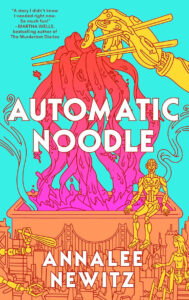
Automatic Noodle was one of those books that was impossible to avoid in certain spaces last year. I haven’t been particularly wowed by the cozy trend in SFF, so I let it pass upon release, figuring I’d circle back after the inevitable Hugo nomination. Fast-forward a year and it’s been shortlisted for Best Novella, so it was time for me to dig into Annalee Newitz’s postapocalyptic robot noodle story.
Automatic Noodle takes place in a San Francisco scarred by the effects of the war for California’s independence from the United States. It stars four bots grinding out hours in a restaurant designed to maximize profit on the cheapest food possible before the inevitable poor reviews force a rebrand. But after the owners skip town, the leads decide to take over the lease themselves, working to pay off their debts by selling only the highest quality noodles. But with their scheme’s questionable legality and rampant robophobia, it will take more than just a good recipe to keep the business afloat.
While Automatic Noodle typically gets categorized as cozy sci-fi, it’s absolutely not without its share of conflict. Yes, there’s a focus on food and on a found family pulling together to make a better life, but there’s also prejudice, rampant poverty, debt-slavery, legal inequality, and plenty of past trauma. The overall tone is a hopeful one, but there’s a lot going on here.
Unfortunately, the proliferation of storylines in such a short book is mostly to the novella’s detriment. All of the elements are things that can work, but working together is a different challenge, especially with a limited page count. It’s not a good sign when consideration of every subplot just makes me think of another book that did it better, but that’s how I found myself responding to Automatic Noodle.
Let’s start at the beginning, with the traumatic backstory. The book opens with a military robot waking up in dangerous conditions with no memory of how he had come to be there. It’s an almost identical setup to Suzanne Palmer’s Ode to the Half-Broken (which was written afterwards—I’m making no plagiarism accusations, just comparing the development of different storylines). But in Palmer’s book, the lead wrestling with a violent past is a unifying thread tracing through the entire novel. Automatic Noodle, on the other hand, quickly leaves the first perspective character to introduce three more, and when it does eventually return to the traumatic backstory, there has been far too little emotional build-up to generate any real impact. If potential readers have fancied Murderbot in a noodle shop, they’re bound to be disappointed.
The three other major characters all receive their own backstories, and while some are developed better than others, the split page time makes it hard for any one to generate a strong emotional response. At its best, it can drive home the camaraderie between two characters, but more often, it interrupts the main story so that one character can address some psychological hangups that aren’t sufficiently established as to be meaningful to the reader.
Another natural point of comparison for Automatic Noodle is Legends & Lattes, another cozy tale in which a non-human gets into the food and beverage industry and must try to keep it afloat despite significant obstacles. I found Legends & Lattes a pleasant but uninspiring read, but I appreciate it a bit more in comparison with Automatic Noodle. Legends & Lattes keeps its focus on a single perspective character, and her love of coffee and desire to bring high-quality beverages to the world around her truly leap off the page. Automatic Noodle does have a character with a similar noodle obsession, but the split focus keeps it from ever developing in the same way.
There is a bit more focus on the actual process of noodle-making, but even that lacks the descriptive punch that makes the reader taste it. I fully expected this read to result in some noodle cravings, and I was surprised to find that it didn’t. I can’t help but compare to Light From Uncommon Stars, another story with found family elements and a whole lot of food. But Light From Uncommon Stars brought the setting vividly to life and described food in such a way that one could almost taste it, and I found those elements sorely lacking here.
Perhaps even more than it is a tale of food and found family, Automatic Noodle is a story about overcoming the evils of bigotry. It’s not always clear whether robophobia is meant as a stand-in for homophobia or nativism—I lean a bit towards the latter, but the answer may well be a bit of both—but either way, it’s stridently clear about the travails that people must go through to simply exist in a prejudiced world. This plot thread is more developed than any other in the book, but once again, Automatic Noodle fails to fully bring it home. There’s not much exploration of why people worry that robots are stealing their jobs, and the actual threats tend to be overcome too easily to deliver real tension. Part of that is simply the attempt to maintain an overall lighter tone by keeping the crises to a minimum, but again, the balance doesn’t sit quite right, and it has me thinking of another book from 2025 that manages more deftly. If Wishes Were Retail by Auston Habershaw also centers a small shop under non-human leadership and heavily features worries about humans losing their jobs to speculative interlopers. But that one both makes the concerns feel more real and addresses them more thoroughly than Automatic Noodle, all while maintaining tonal continuity.
This review has grown long, and the volume of words spilled is an indication that Automatic Noodle is attempting something worth talking about—several somethings, in fact. But it doesn’t commit thoroughly enough to any of them to really drive home any of the major themes or subplots. Either a tighter focus on a narrower set of concerns or expansion into a novel that allows each element room to breathe might have made something compelling out of Automatic Noodle. Instead, each element merely leaves me thinking of other books I’d recommend instead.
Can I use it for Bingo? It’s a Book Club selection with a Non-human Protagonist. It could be hard mode for Feast Your Eyes if you have a little ambition in the kitchen.
Overall rating: 10 of Tar Vol’s 20. Two stars on Goodreads.