Tamora Pierce’s Tortall universe seems to be a cultural touchstone for so many women in fantasy, but (in no small part due to having never been a girl reading fantasy), I’d never delved into it. But the combination of peer pressure and a couple auspicious Bingo squares gave me a reason to move the Protector of the Small quartet up my TBR.
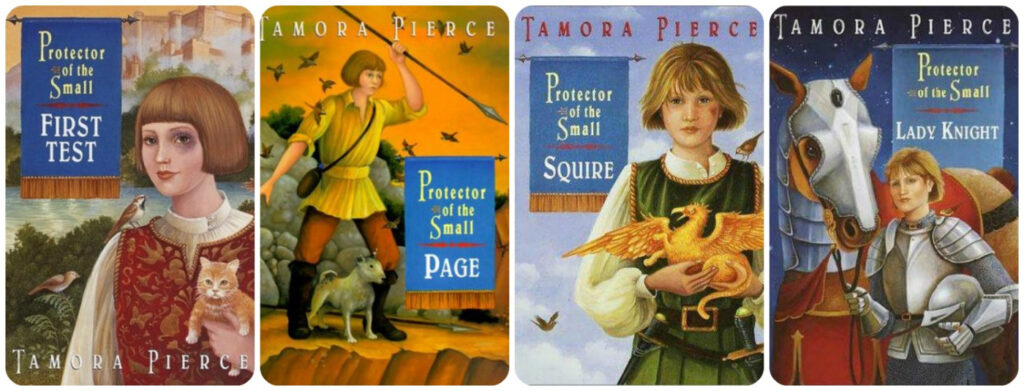
Protector of the Small stars Kel, a girl returning to Tortall following her family’s diplomatic posting to an island nation with strong Japanese inspiration. She returns in hopes of becoming the first to take advantage of new laws allowing girls to train as pages (and subsequently test into positions as squires and ultimately knights). The book titles—First Test, Page, Squire, and Lady Knight—leave no doubt as to whether she will be successful, but that doesn’t mean there isn’t plenty of room for compelling stories along the way.
Ordinarily, I would’ve included somewhere in the background summary that this series is aimed at a middle-grade audience, which was how it was pitched to me and seems to be the general online consensus. But I’m not entirely convinced that it’s true—in fact, I’m not quite sure what sort of audience Pierce had in mind. The first book seems clearly aimed at middle-grade readers, and despite the lead being forced to navigate sexual mockery at a young age, the second is tonally similar. But the third and fourth roughly double the page count and feature Kel having graduated the academy and living as a (young) adult. It certainly wouldn’t be the only series to grow with the characters (Harry Potter was famously doing the same thing at about the same time period), but the speedrun from childhood to maturity leaves me feeling like the first book is pitched too young for adult readers but simultaneously that its primary-school fans may not be ready for the sudden jump in maturity level.
The audience question creates a series-level pacing issue that is particularly egregious in the second book, which covers three years in just over 200 pages. A truly tremendous ending goes a long way toward redeeming the individual book—and you see something similar on a series level—but there are times where it feels like a book of Cliff’s Notes to connect the childhood story and the adult story.
It’s a substantial flaw, but the good news is that there aren’t many more. The attitude toward casual sex (overwhelmingly positive, with very few reservations) does give me some additional pause in passing the series to my own children, but the vast majority of the series is excellent. The school arc, featuring a good-hearted lead forced to deal with complicated politics and more than a few hostile classmates, reminds me immensely of a middle-grade version of Inda, one of my own favorite fantasy novels (as First Test was published a decade earlier, it’s more accurate to say Inda feels like an adult Tortall, but I read the two in reverse publishing order). Kel is doggedly committed both to physical excellence and to protecting those who cannot stand up for themselves, a combination that’s endearing to the reader and that makes a real difference in the canonical academy culture. Furthermore, she is constantly forced to choose between her own advancements and her commitment to protect the small, making for moral quandaries more breathtaking than any physical threats.
As the series progresses, those schoolyard tests tend to recur on a larger scale, with Kel’s burgeoning leadership roles threatened both by bad actors within her own chain of command and by enemies seeking to gain an advantage by abusing the weak. Her handling of these trials is more mature in the later books than in the earlier ones, but there’s a clear line of character development connecting the nervous child with the adept lady knight. The first books may not target the same audience as the last two—which is not, I’ll note, a reason adults should avoid them!—but they set it up wonderfully all the same.
On the whole, Protector of the Small suffers from some early-series pacing issues and a murky intended audience, but it’s an immensely readable series with a lovable main character whose determination and kindness are truly inspirational.
Recommended if you like: kind leads who actually make a difference, girls breaking into male-dominated spaces.
Can I use it for Bingo? I’m using it for Knights and Paladins, but a new Bingo comes out literally tomorrow, so we’ll have to reassess.
Overall rating: 16/20 for the first two books, 17/20 for the last two, 16/20 for the series as a unit.