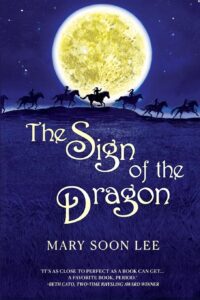
I’ve never been a big poetry reader, and I know almost nothing about speculative poetry. So I was initially a little skeptical about Mary Soon Lee’s epic The Sign of the Dragon. But with a handful of friends providing plenty of peer pressure, an intriguing opening poem, and an online book club to read with, I decided to give it a go. And while I can’t compare it to other novels in verse, I can certainly review it from the perspective of someone who primarily reads prose—which I’m sure describes plenty of other potential readers.
The Sign of the Dragon is split into six sections with around 50 poems each, all detailing the reign of Xau, the kind-hearted, horse-loving, reluctant ruler of the Chinese-inspired nation of Meqing. The poems range in length from a single line to several pages, and they cover a wide cast of characters. Xau himself, of course, takes the lion’s share, but we frequently see poems from the perspective of his guards, and it’s not unusual to have poems from the perspective of servants, rulers of other nations, monsters, or even animals. With perhaps one exception, each of the six sections has its own major plot, but they build on each other, with the individual poems the threads in a truly epic tapestry.
As I said, I’m not a regular reader of poetry, and I won’t spend much time evaluating the poetic structures. The majority of the poems read like free verse, with the occasional rhyming or prose section immediately noteworthy as a change in perspective. But the poems themselves are often lovely, and the novel’s poetic structure gives it a tonal flexibility that I doubt would have been nearly so effective in a prose format.
Almost every section features some form of armed conflict, and the book never goes long between heart-wrenching deaths. But each section also includes plenty of moments of hope, celebration, or quiet pleasure. There are birthday gifts, fireworks shows, peaceful outdoor excursions, riddles, and more than a few jokes. And even when one of those moments happens shortly after a poem of loss, it doesn’t ring false. After all, many individual pieces cover only brief snapshots in the lives of the characters, and moments of levity within dark times are a fundamental part of the human experience. The poetic structure allows the story to jump between happy and sad moments without dedicating much space to transitional exposition that may break the narrative flow—it’s simply a story with a different narrative flow than you’d find in most prose.
The Sign of the Dragon is noteworthy for its depth of characterization, with the guards in particular developing rich personalities when they would blend into an amorphous unit in so many other stories. And they aren’t the only ones—there are plenty of other secondary characters who are eminently recognizable as fully-recognized individuals even when only garnering the occasional perspective poem. And yet, even with such a large cast, this is Xau’s story.
Fortunately, Xau is an absolutely delightful character. He’s unerringly kind and self-sacrificial to a fault. Of course, he’d not agree that it is a fault, and the combination of competence and unwavering character serve to make him an almost mythic figure worthy of such a sweeping epic. But the fact remains that his sacrifices cost. Did they not, he would read as so absurdly perfect that it’s difficult to invest in his story. But while his well of patience and selflessness may be unrealistically deep—not to mention a dash of magic that is literally the stuff of fantasy—he bears physical and psychological scars as the direct result of his actions. He loses friends and loved ones. He loses physical capacity and mental stability. And the accumulation of losses ground the narrative in a way that drives it home not as an exaggerated morality tale but as a gut-wrenching story about fallible people who become intensely sympathetic as the story progresses.
The somewhat episodic structure of the book’s six parts do represent a bit of a weakness, but not a debilitating one. Almost every section features the forging of human alliances and battles against deadly foes, whether human or supernatural. And in the first half of the novel, it works wonderfully. But in the fourth and fifth sections, when so many plot beats had already been seen before, the repetitiveness does take some of the shine off the magic. Not too much shine—it’s still an enjoyable read throughout, and it gathers together for a sixth part that provides a fitting and thrilling capstone for the novel as a whole. But. . . well, just like its main character, The Sign of the Dragon isn’t pure perfection, merely very, very good.
On the whole, it’s a beautiful story that I can’t imagine being told any other way. It’s thrilling, poignant, funny, uplifting, heartrending. It’s simultaneously poetic and easy to read, both wide in scope and eminently approachable. The Sign of the Dragon is a truly breathtaking epic, and one I highly recommend.
Recommended if you like: kind protagonists who actually make a difference, novels in verse, epic poems.
Can I use it for Bingo? It’s hard mode for Book in Parts, Parent Protagonist, and Small Press. It’s also a Book Club book written by an Author of Color.
Overall rating: 18 of Tar Vol’s 20. Five stars on Goodreads.