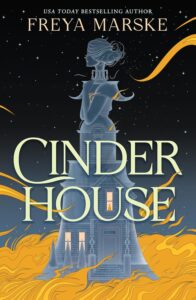
I’d heard some positive buzz about Freya Marske’s Cinder House before awards shortlists were released, but seeing as how I didn’t seem to fit any of the target demographics, I let it pass by until a Hugo nomination sent it climbing back up my TBR. Even though I hadn’t picked it off the shelf on my own, I was excited to see a novella finalist by a new-to-me author, and while it may not be the perfect book, Cinder House lived up to that excitement.
I knew fairly little going into the book, with a few hints about the marketing categories but little concrete details. I didn’t even realize it was a Cinderella retelling, for all that “Cinder” appears in the name. But Cinder House twists the classic fairy tale right up front, with Ella dying in the opening paragraphs and immediately reappearing as a ghost tied inextricably to the house. Many of the traditional plot beats follow, but the small complication of a dead main character remains a refreshing twist that keeps the story from settling too deeply into familiar grooves.
By and large, a fairy tale retelling isn’t out to surprise you with twists, and Cinder House is no exception here. For those who paid any hint of attention to the marketing going into the read, it’s even less apt to surprise, as there are only a couple possible endings that fit the bill. But creativity and quality storytelling go a long way, and both are firmly in evidence here.
Ella’s death is obviously the big change that drives the vast majority of unusual choices down the line. As a retelling, Cinder House actively seeks to hit the familiar plot beats—the fairy godmother, the charming prince, the glass slippers, etc.—but a dead Ella means that many of those beats will come off a little differently than the reader expects. It doesn’t make for any true shocks, but there are enough changes to keep it from feeling like a story that’s been told a thousand times.
It also helps to have a talented storytelling at the helm. A shocking claim, I know, but it’s true. Cinder House immerses the reader immediately into Ella’s point of view and remains immensely readable from start to finish, with secondary characterization that’s strong for such a short book and with climactic scenes that thrill even when the reader sees them coming. It’s just a really fun read from start-to-finish, and while it may be hard to become iconic on pure readability, it still makes for a wonderful experience.
The one real flaw here is one subplot in particular that’s built up to be a dramatic revelation and ends up overshadowed by the main story. Expanded into a full-blown secondary plot, it would’ve enhanced the story’s Gothic stylings and deepened the characterization, particularly of the evil stepmother, though it likely would’ve turned Cinder House from a novella into a novel. Excised entirely, the story would’ve missed nothing but potential, and it would’ve lent a bit more consistency to Ella’s character. But the awkward in-between makes no real mark on the characters and only distracts from the main story, leaving the reader wondering why it had loomed so large in the early stages.
But ultimately, one underwhelming subplot takes away little from an overall story that provides such a fun and refreshing twist on the classic Cinderella narrative. Cinder House probably isn’t the book that will have you still thinking about it ten years from now, but it’s an excellent read all the same.
Recommended if you like: uncommonly clever fairy tale retellings.
Can I use it for Bingo? It’s hard mode for The Afterlife and also features Politics, Feasting Your Eyes, and is a Book Club selection.
Overall rating: 16 of Tar Vol’s 20. Four stars on Goodreads.