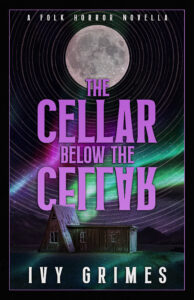
This review is based on an eARC (Advance Reading Copy) provided by the publisher in exchange for an honest review. The Cellar Below the Cellar will be released on March 25, 2026.
I don’t believe I’d read Ivy Grimes before, but I was offered an ARC of The Cellar Below the Cellar and figured there was no reason not to give it a try. It’s pitched as a folk horror novella inspired by a fairy tale I didn’t know, so there wasn’t much reason to think I personally would be the best reader for it. And while others are doubtless better situated to put it in context of other similar works, I found from the first pages that I wanted to keep reading.
The Cellar Below the Cellar follows a 30-something woman who had been visiting her rural grandmother when a solar storm knocked out all electronics across the neighborhood—and presumably across the world. And yet her grandmother doesn’t seem much surprised and springs immediately into teaching their neighbors how to survive in this new, low-tech world. While full of ideas, her grandmother is sparing with information and consistently frustrated with the lead’s indecision and fear of the titular cellar below the cellar, where lurks something magical, and perhaps horrible. In case the “presumably across the world” line didn’t clue you in, The Cellar Below the Cellar isn’t interested in exploring the wide-ranging societal impacts of the event. Instead, it focuses on the few people within walking range, with a particular focus on the progression of the lead’s ability to navigate both the mystical and the mundane.
While “something dark and scary in the cellar below the cellar” sounds like a straightforward horror premise, The Cellar Below the Cellar doesn’t necessarily feel like a horror story. There are several creepy elements that have the characters themselves terrified, but they engender more curiosity than fear in the readers. I’ve also seen it pitched as an adult coming-of-age, and that’s a bit closer. While the lead is fully grown when the story starts, she knows nothing of magic or how to handle an apocalyptic event, leading her to rely almost entirely on her grandmother for direction. The way that changes over the course of the novella feels like the tale’s major arc. Certainly, magic is revealed, but this isn’t the sort of book leading to a big, supernatural battle, nor is it a book about the reshaping of the world writ large. Instead, it’s about coming to terms with the natural and supernatural world as it is, right here and right now, and learning how to live in that knowledge.
It also isn’t the sort of book that’s going to spoonfeed the reader with clean, simple characters. The opening chapter leads with a demon-hunting pastor that I was utterly convinced would be the villain, just as I was convinced the lead’s grandmother would be the implacable, wise mentor. The truth is much more complicated. The lead’s grandmother is implacable and expert in key disciplines—both magical and mundane—but she’s often callous and is so extraordinarily tight-fisted with information as to almost seem like the villain at times. The pastor, on the other hand, seems earnest and likable enough, and there’s no voice-of-God to definitively tell the reader exactly what to make of the demon-hunting. This generalizes through the novella: the characters are consistently messy, with their own strengths and weaknesses and no one trait that defines their entire person, no matter how important that trait may be.
Ultimately, The Cellar Below the Cellar is an engaging novella for fans of small-scale stories with unexplained weirdness. It does offer a satisfying arc, but not an epic one, and it has no interest in ensuring that every flawed character is punished. The prose style doesn’t accentuate the horror elements so much as it centers the lead’s psychological journey in the ways she responds, but it’s a style that absolutely makes you want to keep reading. It’s not in my typical niche, and I’m probably not the book’s ideal audience, but I’m quite sure it will be a delight for readers looking for its particular sort of oddness.
Recommended if you like: weird folk tale retellings, coming-of-age structures, folk horror?
Can I use it for Bingo? The delayed publication date most likely pushes it to next year’s Bingo, where it will likely hit Published in 2026 and Indie Publisher. For anyone who gets an advanced copy or reads immediately upon release, it’s good for Hidden Gem this year.
Overall rating: 15 of Tar Vol’s 20. Four stars on Goodreads.