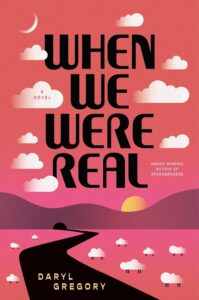
I’ve been hearing Daryl Gregory recommended for a while now, but I hadn’t really given him a try until reading the novelette “Second Person, Present Tense” a few months ago. That was good enough to convince me I should read more, and so I decided to jump into his most recent novel, When We Were Real.
When We Were Real takes place in a simulation, and everybody knows it. One day, the entire world had been greeted by a message saying as much, complete with a smattering of impossibilities to prove it. The responses had been varied, with violent cults springing up, alongside a massive increase in psychological modeling research and a fair few people mostly going about their lives without thinking too much of the simulators. This story spotlights a handful of characters coping in different ways, all brought together on a bus taking them on a tour of impossibilities across the United States.
You may note that my usual paragraph providing necessary context features mostly worldbuilding and not much plot. That doesn’t mean that there isn’t a plot, just that it doesn’t take center-stage. Instead, it’s an exploration of ordinary people figuring out their life in extraordinary contexts. There’s a pregnant teen and a woman suffering chronic pain who see opportunity in changing their approach to the simulation, a conspiracy theorist looking to uncover the trick behind it all, a terminally-ill engineer spending his last days traveling with a friend, a tour guide who is in over her head, and more than one character dragged along by strong-willed relatives. The novel offers snapshots into all of their lives, and while they can be over-the-top at times, the snapshots are generally compelling and humanizing.
I often complain that literary-leaning speculative fiction tends to devolve into a thriller plot structure, and When We Were Real is no exception. There’s a scientist on the run, pursued by both government and vigilante groups, and her flight becomes the primary plot-driver as the story progresses. This is not necessarily a flaw of the book—after all, having some plot structure is probably valuable—but it is a negative for me as a reader, as I don’t tend to find extended chases particularly engaging. It provides an opportunity to dig into some of the philosophical and ethical implications of the simulation, which do make for an interesting read, but the chase itself isn’t as gripping as a main plot needs to be.
Fortunately, the quality of the writing and of the smaller characters make When We Were Real a book that’s still worth reading. There are plenty of characters who are introduced in a way that makes them unlikable—an influencer obsessed with metrics, a conspiracy theorist, a judgy old woman who does nothing but complain—but as the story progresses, we see deeper struggles and motivations that make them more and more sympathetic. And there are others whose plights are more relatable from the jump. The dying engineer and his best friend who wants him to seek life-saving treatment, for instance, makes for a compelling storyline whether they’re all in a simulation or not.
Overall, and perhaps ironically in a book about impossibilities, When We Were Real is a book at its best when digging into the mundane struggles of ordinary people. The overarching chase plot is unexceptional, but the writing quality and character details make it a worthwhile read.
Recommended if you like: literary speculative fiction, large casts.
Can I use it for Bingo? It’s hard mode for Book in Parts and Impossible Places. It’s also Published in 2025.
Overall rating: 14 of Tar Vol’s 20. Four stars on Goodreads.