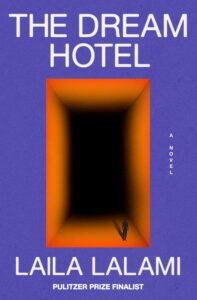
I only occasionally dip into speculative litfic, largely with mixed results, so despite her fame, Laila Lalami’s The Dream Hotel wasn’t really on my radar until a Redditor recommended it for fans of Octavia E. Butler and Emily St. John Mandel. Seeing as how Clay’s Ark and Station Eleven were two of the best things I read in 2025, I immediately put in a library request for The Dream Hotel. And wouldn’t you know it, I was rewarded with my new favorite publication of 2025.
The Dream Hotel takes place in a future America that has significantly curbed violent crime by leveraging its vast data stores to assess each individual’s chances of committing one and detaining those who score too high. The lead, despite her academic credentials, stable job, and stable family, finds herself on the wrong side of the algorithm, condemning her to a precautionary detention that theoretically isn’t prison and theoretically isn’t long-term but that sure feels a lot like both. The bulk of the novel follows her as she tries to navigate the kafkaesque maze of regulations to regain her freedom, interspersed with flashbacks to the red flags in her former life and clippings of regulations, assessments, and messages that hammer home the maddening powerlessness of those detained.
The whole theme of indefinite detention in a not-technically-prison calls to mind the many stories of people being held against their will in mental institutions, and even though the sort of institution has changed, The Dream Hotel shares a lot of that DNA. It wonderfully captures the powerlessness of the institutionalized, the byzantine system one must navigate to prove they’re safe to be released, and the frightening power of the rank-and-file enforcers. Of course, as a book set in the future, plenty of its concerns aren’t here yet, but we can certainly see the seeds.
But even before digging deep into the themes, The Dream Hotel is remarkable for just how well it immerses the reader into the lead’s story. Rarely am I fully invested in a novel in the first chapter, and even more rarely am I fully invested early in a novel leaning to the literary side. But The Dream Hotel had me from the word go. The lead’s day-to-day life in detention is described so expertly as to have me hanging on every individual scene, even having no idea about the broader plot arc. And it only gets better as we see more and more glimpses into all the mundane trials that had brought her to such a place.
It is infamously easy to read tales of people who are wrongfully detained—or even physically brutalized—and find reasons not to worry about it. To find some glaring flaw in the way they have lived their life to put them on the radar of law enforcement, or in their demeanor during the encounter that prompted the fateful action. But The Dream Hotel is remarkable for just how ordinary it feels. Yes, there may be an element of racism involved, and the lead had certainly let her frustrations get the best of her in interactions with customs officers. But she had followed the success sequence—degree, then job, then marriage, then children. Her customs encounter had come upon return from a business trip. In life writ large, she was doing everything right. And the algorithm had flagged nothing that couldn’t easily happen to anybody.
I do not share a religion with either the author or main character, but my religion emphasizes the brokenness of all humanity in a way that deeply resonates with The Dream Hotel. I’ve heard a pastor say that “all of us are three bad days away from being a tabloid headline, and most of us are already on day two.” The fictional analogue here is that we’re all about one bad day from being flagged as a violent crime risk. It’s a universality that implicitly pervades the text and that is even made explicit at one point when the lead—who had expended so much energy trying to be the model detainee—gets her term extended, and a friend remarks that she just had a bad day and that it happens to everyone eventually. There are, of course, some typical exceptions (the rich, for instance, tend to be more insulated from consequences of their own actions), but I’m not sure I’ve ever read a novel that does a better job of making the overreaches of the justice system feel like such a universal threat.
Ideally, people wouldn’t need to feel personally threatened in order to care about injustice, but nothing in the world is ideal, and an understanding of how easy it is to be caught up in the system should foster empathy for those who are caught up—not just in the science-fictional preventative detention but in the flawed systems that exist right now in so much of the world. It’s also a powerful reminder that a system that effectively deters crime may yet be unjust. The Dream Hotel never pretends that the system doesn’t drastically decrease violent crime. Instead, it draws the eye to the human cost of that prevention. Debates about widespread data collection and the use of algorithms to make decisions that indirectly impact the lives of everyday people are not going away any time soon, so the message of The Dream Hotel feels particularly timely.
It’s also timely in plenty of other ways. The racial biases and the role of customs and immigration in kicking off the story make it feel almost too timely. And while the power of run-of-the-mill cops and prison guards has been well-known for quite a while, The Dream Hotel applies that to a world of ubiquitous algorithms in a way that rings disturbingly true. The people who make decisions about what data gets recorded and what merely warrants a verbal warning have a stunning amount of invisible power when that data determines who is locked up and who goes free.
The trouble with such a tremendous book is that it’s difficult to find space to talk about all of it. I’ve hit the word count of a typical review and feel like I’ve barely scratched the surface. There’s an organized labor subplot that’s plenty compelling, and the way the lead’s very dreams are weaponized against her may be one of the hardest-hitting aspects of the entire book. I don’t share a lot of demographics with the lead, but I am a spouse and a parent of young children, and the nightmares and intrusive thoughts that come when you’re struggling to care for the completely helpless and not even given adequate rest before you do it again? Well, I may have used the phrase “all too real” one too many times here, but the shoe fits. The psychological turmoil of dreams that don’t represent your own self-conception are on full display, and they make the safety algorithms all the more terrifying.
In short, this is my book of the year. It’s one of my favorite books ever. It’s absolutely impeccable both in its characterization and its themes, making for a read that had my heart racing from the opening pages and led to the sort of reading binge I hadn’t done in years. It would be a five-star read as a character study or as a social commentary. As both? It’s the best litfic I’ve ever read. I have seen some complaints about the ending, and I do understand them. There’s plenty that isn’t resolved. But in this type of book, I’m tempted to argue that the ambiguity is as much a selling point as it is a negative. And even if it’s not, the rest is so good as to make for an absolutely jaw-dropping read in spite of it.
Recommended if you like: litfic, character-focused novels, social commentary.
Can I use it for Bingo? It’s hard mode for Stranger in a Strange Land. It’s also written by an Author of Color, Published in 2025, features Epistolary segments, has a Parent protagonist, and I’d argue has a Down With the System plot.
Overall rating: 20 of Tar Vol’s 20. Five stars on Goodreads.