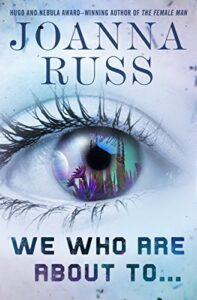
Joanna Russ is one of those figures from before I started reading sci-fi who is sufficiently renowned that I’ve been meaning to read her for a while but not so ubiquitous that I’d already done so. But I had a bit of a gap between library holds, and the trim length and glowing reviews of We Who Are About To… made it a great candidate for the moment.
We Who Are About To… is a clear-eyed subversion of a classic sci-fi trope. A spaceship lands on an alien planet, and with little chance of rescue, the survivors seek to build a life where they are. Only in this case, there won’t be a happy ending, as is clear from the book’s opening lines:
About to die. And so on.
We’re all going to die.
Unlike in so many classic tales, the lead is no plucky adventurer or canny scientist using their spirit and intellect to find a way to survive. Instead, the lead is completely resigned to her fate from the very beginning. She cannot fathom there are any reasonable chances of survival, and even if there were, she’s not convinced she could scrape out any sort of life worth living. This introduces the two main conflicts of the book. First, an interpersonal conflict with fellow travelers who take issue with her persistent pessimism. And second, an internal conflict as the psychological implications of her impending death become stronger and stronger.
The whole thing is told in an epistolary format, with the lead recounting her experiences into an audio diary that she assumes no one will ever read. It’s a setup reminiscent of I Who Have Never Known Men (which came later), except with a wildly different person in the central role. There are hints in her backstory that she’s become jaded and cynical even before the crash, but in the aftermath, she’s a consistent voice of pessimism. Of course, she would call that being a voice of reason, and there’s a whole lot of occasion to prove her right.
The chances of rescue are so slim as to be a rounding error. There’s no clear evidence of a reliable food supply, and there are confusing indications that the climate may not be especially hospitable in the long-term. And yet the dominant attitude seems to be one focused on rebuilding civilization—leading to one of the more memorable one-liners:
Civilization’s doing fine. We just don’t happen to be where it is.
The secondary characters aren’t drawn with an abundance of depth, and it’s possible that their naïveté is exaggerated by the lead’s perspective. But the way they recreate oppressive power structures in trying to force their vision on their fellows is a stark repudiation of the more optimistic sci-fi tropes. Society may be elsewhere, but human depravity is right here.
The second conflict requires a much deeper dive into the lead’s psychology, and as the hopelessness of the situation begins to weigh heavier and heavier, that dive becomes much less organized and more a series of stream-of-consciousness monologues, touching politics and religion, personal guilt and capitalist oppression, and whatever else happens to flit across her mind. For instance, she returns on a couple occasions to her days of protesting and how the demonstrations were so thoroughly shut down by people in power. But if there is a main theme in this section, it’s one of second-guessing the choices that led her to this point.
The chaotic rawness of the monologues ring psychologically true, and as she reflects on various actions, considering them from this angle and that, it lends a lot of depth to her characterization. She’s not just a disillusioned cynic—in many ways, she’s the most clear-eyed figure in the book—but neither is she especially sympathetic, and her self-critical reflections have just as much a point as her self-justifying ones.
The biggest downside of this second conflict is simply how long it meanders. Looking back after the fact, it’s easy to appreciate the character development. But in the moment, the repetition and aimlessness can make for a bit of a slog to read. I can’t help but wonder whether the whole thing would’ve been more effective as a novella than as a short novel.
That appreciation coming mostly after the fact isn’t quite so extreme with the interpersonal conflict as with the internal one, but both have a tendency to be a bit more memorable than enjoyable. There are some fantastic one-liners and observations about humanity in the early stages, but the story is still prone to drag at times, even before breaking down into monologues. Perhaps this would hit harder for a reader thoroughly steeped in the sort of sci-fi being subverted, but for a reader coming to it fifty years later who only understands a portion of the references, it can feel a bit thin for novel length.
Ultimately, there’s a lot to appreciate about We Who Are About To…, even if the reading process itself isn’t always enjoyable. It’s a short novel, but it’s not an easy one to blast through, and while there are a few elements that justify the acclaim (and likely would have been more still for a contemporaneous reader), I still wonder whether it may have been more incisive in shorter form.
One final note for those reading the edition with the Samuel Delany introduction: it bafflingly avoids talking about the internal monologue to avoid spoilers and yet still spoils most of the plot. Read it afterwards.
Recommended if you like: feminist subversion of classic sci-fi, chaotic internal monologues.
Can I use it for Bingo? It’s hard mode for Epistolary.
Overall rating: 13 of Tar Vol’s 20. Three stars on Goodreads.