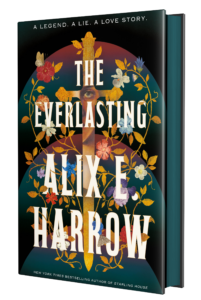
I’d only read two previous novels by Alix E. Harrow, but her prose consistently pulls me in the story, so when I started hearing hype for The Everlasting, I decided to give it a shot.
The Everlasting is a time-loop story about a legendary knight and the scholar studying her, featuring lots of digging into the ways in which national myths can reshape the political climate, as well as a romance that seems doomed in every iteration. The big question is whether the co-leads can find a way to break the loop.
As expected, I found The Everlasting to be a pretty entertaining read. Harrow’s prose style leans a touch flowery, but in a way that doesn’t distract from the flow of reading. She’s written a fair bit at this point, so there’s a good chance that potential readers already know whether or not they like her style. If you do, you’re going to have a good time here.
Apart from the writing style keeping the reading experience pleasant and engaging, the biggest strength of The Everlasting comes in the way it examines national myth-making. One of the animating concerns in the initial scholar segments is the way in which the historical versions of the legend seem to sharply diverge from the current narrative. It doesn’t take long to realize that the explanation is the active manipulation of the legend to fit with the various needs of the one doing the manipulation, setting off a storyline that deftly incorporates multiple versions of the legend while firmly hammering home its points about historiography and propaganda.
The time-loop element also provides a satisfying explanation for the heroine’s preternatural abilities, but—as always happens in time travel stories—it also introduces some paradoxical elements. This is lampshaded in-story with difficult questions being answered with a shrug of the shoulders and a comment about time travel being complicated, and for a while, that explanation works just fine. After all, any time-travel story is going to have elements that you just can’t think too hard about. Calling attention to it here allows the reader to focus on the major elements. But as often happens, the complications become harder to dismiss as the plot ramps up, and it hurts The Everlasting in the buildup to the climax.
It’s also a little bit less convincing in the interpersonal elements than I expected, with the deficiency most obvious in the romantic subplot. There’s some degree of magical explanation to the attraction between the two leads, but there’s not quite enough chemistry to take the explanatory pressure off the magic. There’s some pining, and it turns into mutual attraction, and the romance takes off from there. It’s not a bad formula, but it has to strike at the reader’s heart, and it didn’t quite do so for me.
My interpersonal complaints come out again in the relationships between the lead and the villain. The villain is a bit flat and a bit mustache-twirly, which can be okay in a story where the villain is nothing more than a plot device. But The Everlasting dedicates enough energy to the character that it really ought to have more depth or nuance. It’s not the biggest criticism in the world, but it’s a missed opportunity at best and a distraction at worst.
On the whole, the unconvincing interpersonal elements—particularly the romantic subplot—keep The Everlasting from ever building up to “wow” levels. The time loop is used effectively to establish both the threat and the thematic exploration of propaganda, but it doesn’t bear enough weight to be the main selling point. That leaves a very entertaining, easy-reading story with an okay romance and some strong exploration of historiography. “Very well put-together, not the best of the year” feels like a hater take after seeing some of the early reviews, but The Everlasting is in fact a good read.
Recommended if you like: blends of fantasy and romance, Harrow’s style.
Can I use it for Bingo? It’s hard mode for Book in Parts, and is also a Book Club choice Published in 2025, featuring Knights or Paladins and an LGBTQIA+ Protagonist.
Overall rating: 16 of Tar Vol’s 20. Four stars on Goodreads.